 EpocxyCastingResin
Author Archives: EpocxyCastingResin
 EpocxyCastingResin
Author Archives: EpocxyCastingResin
With a large number of different epoxies available on the market, you want to make sure that you get the one that will work right for the jobs that you need to do. When it comes to getting epoxy made for countertops, you need to know that the epoxy you purchase is made for the use that you will put it through, or else it could end up not lasting as long as it should.
Epoxy is a resin that is mixed with a hardener so that you can refinish surfaces with a clear layer of shine and give new life to older, scratched surfaces like countertops, tables, and floors. This mixture is made by blending a base resin with a curing agent that allows the resin to change from a liquid for pouring into a hard substance that dries flat and hard.
Epoxy can be poured onto sanded tabletops to create a shiny, clear finish, or can be used to resurface bathroom or kitchen countertops so that you can cover up scratches and imperfections that have accrued over time with normal wear and tear. Using epoxy with pigments on countertops to create a faux marble look is becoming increasingly popular.
Tabletop and countertop epoxies differ from other mixtures because of the thickness of the pour and the durability. Casting resins and other epoxies are made for thicker pours and can be used for projects like encasing a valuable item in resin or the ever-so-popular river tables.
However, countertop epoxy is a coating epoxy meant to be poured onto a flat surface. Countertop epoxies should be poured with a thin layer (usually up to 1/8 or 1/4 inch per application) and offer a faster cure time because of that thinness. This allows you to use the surface in less time, which is something that is beneficial considering that you will need to use your kitchen to cook. That being said, although most coating epoxies will feel hard to the touch after 12 hours, we do not recommend placing items on your countertop for at least 7 days to allow a cure throughout.
The thinness of the pour doesn’t just allow for faster cure time, but it also allows for a clear finish so that no cloudiness covers the pattern or design underneath the layer. Countertops may have granite or marble material, which has a beautiful pattern, and you will not want to cover or block that. So, having a clear layer will keep that from happening.

Casting resins are better used for certain projects, but when it comes to resurfacing countertops, they should not be used. The main reason for this is the amount of time that they take to cure. These resins are made for deep pours and can take up to several days to fully cure. If you are redoing your whole kitchen, then that means that you will not have kitchen counter space for cooking for that time.
This can negatively affect your day to day schedule and ability to cook and prepare food the way that you need to, and it will make the whole process much longer than it needs to be.
If you use countertop epoxy, then the cure time will only be between 12 and 24 hours. This allows you to use less time to resurface, because the pour is thinner, and you will only have to wait one day before being able to use your countertops again.
Another reason that these epoxies work better is that many of them are self-leveling. This feature allows the mixture to level itself as it is poured so that you don’t have to do it yourself as you work. This keeps the mixture from bubbling up and causing air pockets to form in the surface and keeps the layer smooth and clear in all areas without having to do extra work.
This self-leveling also keeps you from having to use a torch to pop air bubbles that form. Not everyone will have this type of tool to do that, so negating the need for it will allow you to get through your project faster.
Before resurfacing your kitchen counters, you might be asking yourself; how durable is epoxy on countertops? Well, luckily, epoxy countertop durability is very high. This layer creates a solid surface that will last for years and maintains a long-lasting shine as well. Plus, unlike other varnishes and finishes, you will not need to continually reapply this layer to keep it looking like new.
This solid resurfacing epoxy also stands up well to wear and tear with high resistance to scratches and other minor damages that you might see due to heavy use. This material is also crack-resistant and will not be damaged like glass or other coatings and will stand the test of time.
The shininess that comes with a fresh coat of epoxy will last a long time, but when it does begin to dull, you can revamp it with a quick and easy application of mineral oil.
One of the biggest disadvantages of using epoxy is the fact that it is prone to staining. If you have spills or from food or drinks that are not cleaned up right away, then you will likely have to deal with the effects of staining of the epoxy surface. Because it is used on kitchen countertops, this is something that could happen often and could cause the epoxy layer to lose shine and consistency.
However, you can help prevent this by cleaning up all spills as soon as they happen. Using a damp rag with water and soap you can get the food or drink off of the counter so that there is less of a chance that the color will be affected. Also, the use of mineral oil can be used to protect the shine of the epoxy can could be used after cleaning.
Although epoxy yellowing is inevitable with time, it is possible to delay the process by using an epoxy with UV inhibitors, like Promise Epoxy U.V. Art.
Although casting resins and other epoxies may be similar, there are many important reasons why using epoxy that is made for countertops is the best choice for resurfacing. With the clarity that comes with countertop epoxy and the quick cure times that let you back to your regular cooking routine as soon as possible, using an epoxy made for countertops will make the whole resurfacing process a whole lot easier.
When using epoxy resins for resurfacing things around the house, you may find that you can use it for several different projects. From kitchen countertops, bathroom counters, or tabletops, you can add a layer of resin to give a fresh new shine to an older surface and add a layer of protection for the material. However, coating epoxy isn't always the best option to use for certain household projects.
With several major differences between these options, each one has its advantages and disadvantages. The intended use is one of the biggest ways that these choices differ. With epoxy resin being used for coating surfaces, and casting resin being used for casting molds, figurines, and jewelry.
Deep pour epoxy, or casting resin, has different properties that make it a better choice for some projects, like making river tables. With the thicker pour and the slower cure times, this makes casting resin a great option for making these tables.
Besides the difference in intended use, these resins differ because of two major reasons: the thickness you can pour and the cure times. When it comes to the thickness of both of these resins, the deep pour epoxies offer a thicker pour that will cover a lot of surface and volume for larger areas of coverage, which makes them the preferred product to use for river tables.
Coating resins are different because they only allow a thinner pour that doesn’t offer the same amount of coverage of an area, but will allow for multiple layers of resin. This option works better for resurfacing because of the thin nature of the mixture so that you can add a layer of shine to refresh the look of the surface without adding much resin over it. When using table top epoxy for river tables, you will likely need to apply multiple applications to build up your desired thickness. This means also trying to get each batch of epoxy mixed the same color so that you don't see variations of coloring in each layer.
To sum it up, both products can be used for river tables and will still achieve the same outcome. Many still prefer to use table top epoxy because it is often less expensive of a product. But its important to also remember that time is money so its something to consider when estimating jobs for river tables. Deep pour resin, on the other hand, can be used for one single pour of your river.
River tables are made from large pieces of flat wood using deep pour resin to create a solid surface that is clear (or colored with pigment) and shows the grain of the wood.
To begin this project, you want to choose a piece of wood to use. This piece can be whatever type you would like, but getting a flat piece that has an interesting wood grain to it will make the finished project that much nicer. Live edges are increasingly popular for the character that they bring to the table. Then, you will want to cut the wood in half so that you can use both sides to create the river between them.

Next, you will begin to prepare your mold by making barriers to keep the resin in place. This is done by using a mdf or chipboard under the wood for a base, and a seaming tape to these barriers to ensure that they won't allow the resin to seep through cracks or gaps.
Next, you will want to apply a seal coat to help minimize bubbles from appearing in your flood coat. It is best to use a table top epoxy to fill in any cracks or holes and seal the wood from releasing air into the epoxy. Leave the resin to cure for the full amount of time, then sand the area down so that it is even, if necessary. We always suggest scuffing the surface lightly with 320-grit so that the epoxy can properly adhere to the surface. Clean the surface thoroughly after sanding with Isopropyl Alcohol 99%.
Next, you will mix the resin. This is done by using the ratio that is recommended on the bottle of resin that you purchase, typically 2:1. It is critical that each part is measured accurately otherwise, you could encounter curing issues. You will thoroughly mix the liquid until it is no longer cloudy, and then add your pigment if you are coloring the epoxy. Mix again thoroughly and then you are ready to pour. Double check the maximum recommended thickness for the product you are using. If you pour too thick, you could encounter an accelerated reaction, which could lead to heating up, smoking, yellowing, etc.
Once the river is filled, you will likely need to run a heat source (i.e. industrial torch, heat gun) over the top to eliminate small bubbles. The bubbles should be minimal, assuming you applied a seal coat. Once bubbles are removed, you can leave the deep pour resin to cure fully. Again, this can take up to 72 hours depending on the product and room temperature.
After the full cure time, you can check to ensure that the resin is solid, then you can remove the barriers and the base. With the table on its own, you can seal the wood with oil for a more natural look, or apply table top epoxy for a high gloss shine.
Knowing the difference between coating epoxy and casting resin can help you choose the right option for the project that you are working on. Thick pour epoxy has many uses and is a great choice for making a river table. So, if you want a river table to be your next household project, then use these instructions and casting resin to create a new table for your home.
If you are doing multiple pours of epoxy to achieve your desired thickness, or perhaps the result of your first pour didn’t come out exactly how you expected, then you may be wondering if you can epoxy over epoxy. When using epoxy, it can be a helpful process to add a second layer, but you want to make sure to follow the correct procedures.
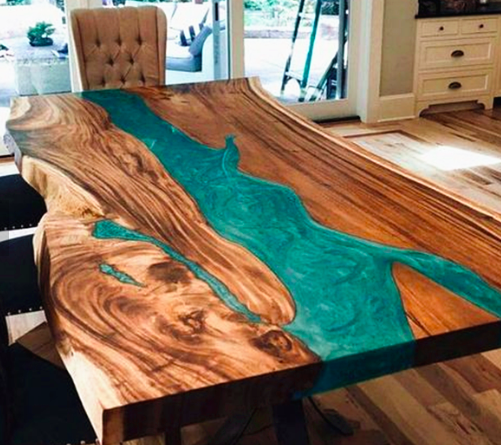
With most coating epoxies, if you are trying to build up to your desired thickness, it is recommended to pour your second coat once the first coat is tacky to the touch (usually 4-6 hours). However, if the coat is hard and has cured, its best to sand the surface before you re-pour in order for the second coat of epoxy to adhere to the first.
If your surface is hard to the touch, follow these steps to prepare for your second coat, and what to do to make sure that your final finish comes out nice and smooth.
Now, you might be asking: can you sand epoxy? The answer is, yes. In fact, it is an important factor in being able to add a second layer of epoxy. You can also give your surface a light sanding in order to achieve less gloss/shine if you desire. But thats a tutorial for another time...

First, if you're epoxy has cured properly and is hard to the touch without imperfections, you can do a light sanding with 320-grit sandpaper in order to scuff the surface so that you can apply your next layer. If your epoxy has not cured properly or you have imperfections, its important to take care of these before you pour your next layer. If your epoxy is still tacky after 12 hours, it is likely didn’t mix the correct ratio of resin and hardener, or you did not mix them thoroughly. In this case, you would need to remove the tacky areas and sand it down, otherwise the layer will remain tacky underneath the new layer or epoxy and you risk your top layer not curing properly as well. This video goes into more detail on how to do that...
When you are all done with the sanding and are happy with the smoothness and evenness of the surface, then you need to begin preparing for the application of the second coat. To do this, you want to make sure that you have a clean surface and work environment that will be free of debris and dust. These things may end up in the epoxy as it dries and sticks to it. This will cause imperfections and may leave the item in the layer.

Cleaning the area that you will be working in will go a long way to keep your epoxy resin clear of dirt and dust or other particles that could show up in it once it is dried. We suggest using Isopropyl Alcohol 99%. It is important that you use 99% as anything else will have water in the alcohol, and epoxy and water do NOT mix.
After you have cleaned the area liberally, then you will want to ensure that you have a new container to mix your resin in. The container that you used last time, for the first coat, will not work because any unmixed epoxy can contaminate your next batch.
Get a fresh container and stirrer, and measure out the 1:1 ratio precisely, or as directed by the brand you are using. If this is not done well, then your resin will not harden as it needs to and will end up with a sticky finish that feels wet to the touch. Once this happens, there isn't a way to fix it without adding more resin, which costs more, so you want to double-check this stage every time you mix to ensure that you are doing it properly and not wasting any mixed product, especially because you won’t be able to use it again.
-Top Epoxy Pick-
When you have sanded down the first coat and finished preparing for the second coat, then you are now ready to pour on the second layer of epoxy resin. When doing this, you want to be generous with your pour so that the entire area is well coated with liquid and the self-leveling feature will work better. It is also best to mix a large amount at a time so that you can pour continuously before the resin hardens, and so you do not run out mid-pour.
Pro Tip: Always have more epoxy on hand than you think you might need. If you run out of epoxy in the middle of your surface, you cannot simply add more to the surface later as you will likely see a visible line where the first and second pour meet.
You also want to use a heat source to pop any air bubbles that may form while the epoxy resin is leveling out. As you pour the mixture onto the first layer, there may be some pockets of air that form bubbles, and using the heat source to pop them and smooth out the area will stop the resin from starting to harden, which can keep the bubble in place and enable you to see the air bubble in the finished coat.
Then, you will let the second layer cure for 12-24 hours. You can continue this process to build the coat to your desired thickness.
Adding a second layer of epoxy resin can be a great way to fix leveling issues, get rid of imperfections, build up the thickness and ensure that your surface has hardened properly so that you have a solid surface once the resin has fully cured. Following these tips will ensure that you get the best results so that your project comes out as good as possible.

If you're preparing to add a coat of epoxy to something, you're definitely wondering how much epoxy you need. This is a question that brings a lot of stress for inexperienced epoxy users, because once you start mixing the epoxy you feel like you're in a race against the clock to get it mixed and poured before it starts gelling, and you want to have everything you need ready to go before you start.
How much epoxy you need will depend on several different factors; there's no one right answer for every situation. We'll go over all the different things you need to take into account before you start measuring out your resin and your hardener, and try to give you as much clarity as possible.
If you're applying epoxy to a porous surface, the answer is probably yes. That changes things a bit when you're calculating the amount of epoxy you need.
A seal coat is a thin layer of epoxy that you apply with a brush. On wood or other porous surfaces, the seal coat prevents air bubbles from forming in the final epoxy layer. It's a thing enough layer that if air is bubbling out of the wood, it won't get trapped by the epoxy. You can just brush over that spot again after the air escapes. Then, once the seal layer has cured, you can apply the final, thicker layer of epoxy without worrying about air bubbles.
General Rule: Most (but not all) coating epoxies cover approximately 12 square feet per mixed gallon (1/2 Gal Part A and 1/2 Gal Part B) at 1/8 inch thickness.
As referenced in our general rule above, 12 sqft is a relatively conservative approach when working with 1:1 coating epoxies. When using a specific brand resin calculator like the one provided by Promise Epoxy, you'll notice that their recommended coverage is actually 16 sqft at 1/8inch. Again, each brand/manufacturer is slightly different in provided or recommended coverage as well as self-leveling thickness. Most often 1 to 1 epoxies will level around 1/8 inch if not dammed or sealed edges, but check with each manager for confirmation. This can often be found in detail pages or Technical Data Sheets.
A seal coat is an extra layer of epoxy, albeit a thin one. You'll need to purchase more epoxy if you're using a seal coat than you would if you weren't using a seal coat. Do not mix the epoxy for both the seal coat and the final coat at the same time, though. You won't be applying the final coat until the seal coat has cured. If you mix all the epoxy at once, it will cure in the bucket while you are waiting for the seal coat to cure.
Another way of saying this, are you controlling the thickness of the coat or letting the epoxy settle over the surface naturally? Damming the edge of the surface gives you complete control over the thickness of the final layer, but it can be difficult to remove the material you used to dam the edges.
If you're using self-leveling epoxy, it is designed not to be dammed in. It will self-level at a thickness of about 1/8 of an inch. Most epoxy sold for home use is self-leveling. As you can imagine, this has the potential to create an extreme mess, so if you're using this kind of epoxy you'll want to cover everything that isn't being coated in epoxy with plastic sheets.
The amount of epoxy you need will depend on whether or not you're letting it self-level or if you're damming it in. For two equally-sized surfaces, you would need less epoxy to achieve a coat of the same thickness if you use a dam than if you let it flow over the edges.
Most epoxies are designed to self-level to create a coat that is 1/8 of an inch thick. Is that thick enough for you? If you are trying to create a thicker coat of epoxy, you're going to need a lot more. If you want to create a thinner coat, well, you'd need less but you also probably shouldn't try that. Epoxies want to settle out to a coat 1/8 inch thick; it's easy to add more to that, but it's very difficult to make it thinner while keeping it level.
Making it thicker also requires the use of a dam or a mold to hold everything in. This means you may not need as much extra epoxy as you might think to create a thicker layer, since you won't have any epoxy running off the edges.
Casting resin is thinner than coating epoxy, which means it spreads more and you could use a smaller amount of it to cover the same surface area. However, casting epoxies do not make good coats. Casting resin is really meant for use in encasing things for display, not forming a protective coating on a broad surface. They will not provide the same level of durability and protection as a coating epoxy will, because they are designed to be poured into very thick layers, rather than spread out over a counter top or a table in a thin layer. They simply aren't strong in layers that thin.
There is a general rule to help you understand how much epoxy you need. For coating epoxies, one mixed gallon (half a gallon each of resin and hardener) will cover twelve square feet at a thickness of 1/8 of an inch. This may vary by brand though, so always check the manufacturers instructions to be sure.
Pro Tip: Always have more epoxy on hand than you think you need. Its better to have more than enough than not enough, otherwise you will likely need to re-sand the entire surface and pour your project again.
Another pro tip: you should always have more epoxy on hand than you think you might need. If you run out of epoxy in the middle of a table, you can't simply apply epoxy to the rest of the table later. There will be a visible line where the first pour meets the second. If you run out of epoxy, you are going to have to sand the first pour, and then re-pour the whole project. This will not only cost you a lot more time and frustration, but also more money.
The exact amount of epoxy you need is going to vary by brand, while the general rule of one gallon per twelve feet is a good starting place, you should always double check before you buy and make sure to buy and mix more than you think you need.
Epoxy is typically as clear as glass, and many people prefer it that way. Unfortunately, even the best epoxy will tend to yellow over time, and what was once a smooth, glass-like covering becomes unsightly and old-looking. Colored epoxies don't suffer from this yellowing effect, so they tend to age better than clear epoxies.

Colored epoxies can also create stunning works of art that just as functional as they are beautiful. A quick image search for "river table" will show you the kind of visual appeal that colored epoxies can have. Those are far from the only thing you can do, though. You can use colored epoxy to fill in cracks and gaps in an old table, creating a totally unique design. You can also use different colored epoxies, applied at different stages, to create multicolored designs.
Colored epoxies have been used to create furniture pieces that sell for thousands of dollars online, but the truth is that they're dead simple to make and use at home. You can make your own designer furniture for a fraction of the cost.

River tables are the most common example of what colored epoxy is used for right now. If you love the look of these tables, but don't want to spend the money, you're in luck. River tables are among the easiest colored epoxy projects you can take on. All you need is a wooden table with at least one wooden side (or just a wooden table of you like the color scheme but don't care about the river effect).
What you'll do is mix up a batch of blue epoxy, and apply it to the center of the table. You can create a perfectly straight line of blue if you want by using small pieces of wood or plastic to line the center of the table. If you want a more irregular design, often called a live edge, you'll need irregular slabs of wood. In these case, the colored epoxy is both decorative and an adhesive to hold the wood together.
Colored epoxy can also be used to decorate stainless steel tumblers, create a unique finish on a counter top or table, and to create works of art to hang on the wall. It's most common use is as a way use irregularly shaped pieces of wood as decoration. It fills in the gaps nicely and creates entirely unique works of art. It can be used anywhere you would use clear epoxy, though.

Using colored instead of clear epoxy prevents yellowing in the epoxy coat. Yellowing occurs over time with clear epoxy, and it doesn't look good. Colored epoxy ages much better than clear epoxy.
Adding pigment to your epoxy is easy. Follow the normal instructions for mixing your epoxy. Once it's mixed, add the pigment and mix it in. That's it. The type of pigment you choose matters a lot, though. There are many different types of pigment, but not all of them are really good for your epoxy.


If you already have some paints lying around, it may be tempting to simply use them to add color to the epoxy. Do not do this. Water or oil based paints will cause problems with the cure and could ruing the epoxy. Remember that your epoxy is based on a precise chemical formula, and adding anything to it could throw off the chemical reaction that makes epoxy.
Important Note: Epoxy and Water/Oil Do NOT Mix! Using water-based or oil-based paints can cause a reaction with the epoxy which could ruin your project, or cause the epoxy to heat up, smoke, crack, etc.
These paints also will not effectively color your epoxy. They are not meant to be diluted, and using them in epoxy would require a lot of dilution, leading to dull colors.
These are probably the most popular choice, because it's easy to mix them in evenly. You can get great results from these and you'll get nice, even coloring. Unfortunately, because they are liquid, even coloring is all you will get. Your epoxy will be one flat color, and will be evenly colored throughout. If that's what you want, then these are perfect. If you want more variation in the coloring, keep reading.

Pigment powders deliver rich, deep colors. They won't mix in as easily or as evenly as liquid pigments, which sounds like a bad thing but it really isn't. It creates slight variations in the coloring that can add a lot of visual interest to the finished product. Instead of a perfect, flat blue, you'll get a blue that varies intensity from one spot to another, fading from bright to dark, royal to light blue, and more.
These are usually the best way to color your epoxy. Mica is a naturally occurring mineral that has a metallic sheen to it. These powders are made of ground up mica with pigment added. With these, you get all the advantages of a pigment powder- deep colors and nice variations- along with a great metallic finish that really makes the epoxy shine.
Remember that making epoxy requires a chemical reaction, and adding too much of any substance can throw that reaction off and prevent the epoxy from curing properly. That's one of the reasons why pigments are so much better than paints or dyes; they're very concentrated, and you only need a small amount to get the color you want. The general rule is that the amount of pigment should be between 2% and 6% of the weight of the mixture. The best way to measure this is with a digital scale.
Lower than 2% and you may not adequately color the epoxy. Higher than 6% and you are likely to interfere with the reaction that cures the epoxy. Start off closer to 2% and add more if you want more color.
These are very generalized instructions, because each brand of epoxy and of pigment may have slightly different instructions for you. While they are unlikely to vary much from what is listed here, always use the manufacturers recommendations when they differ from ours.
Epoxy has many uses in the kitchen. Because it can be both an effective adhesive and a coating material, it has both practical and purely decorative uses. It's strength as an adhesive is second to none, so you may be considering using it to repair broken items in the kitchen. Because it can work equally well with wood, plastic, fiberglass, ceramic or even metal, you can use it to repair almost anything.
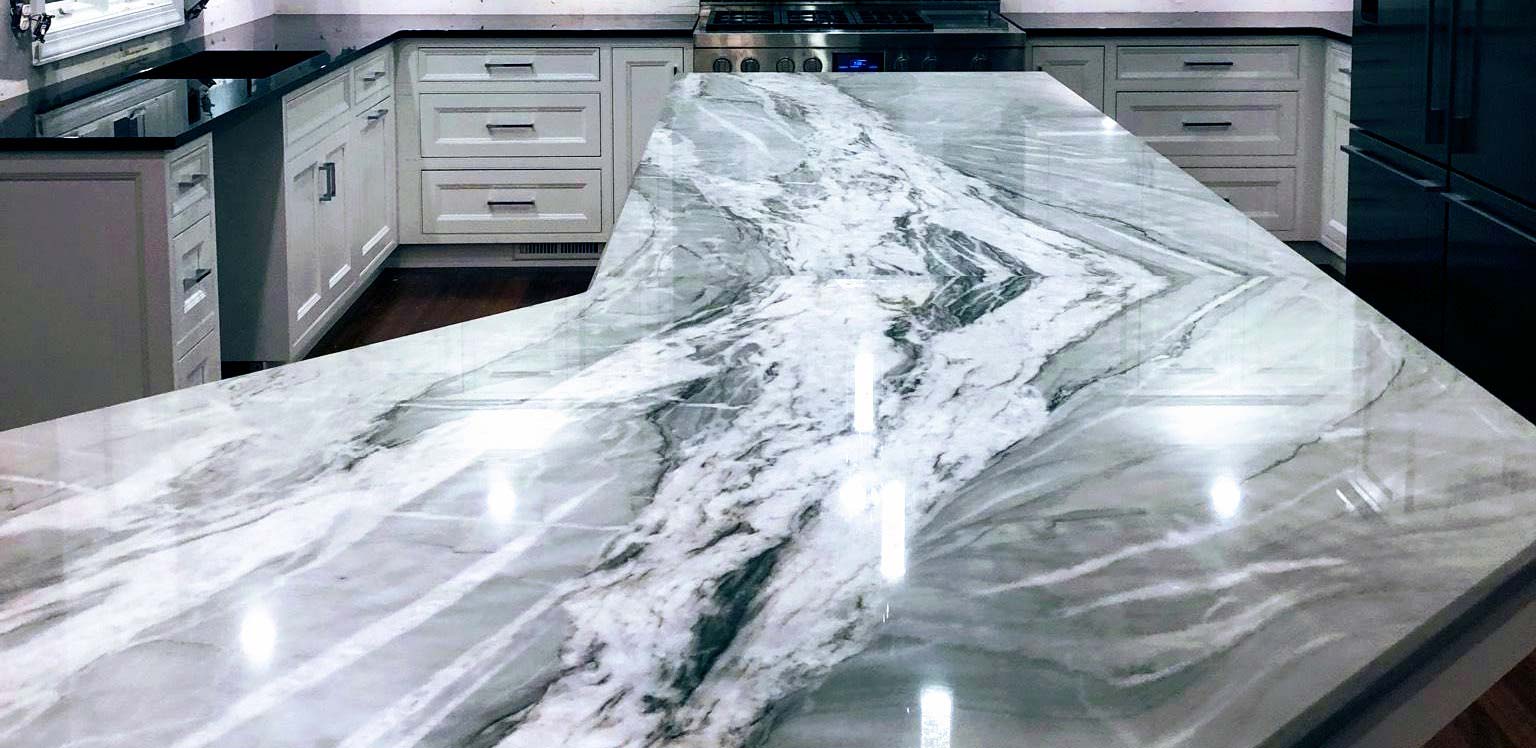
Once it's cured and dried it's crystal clear and very hard, so it has plenty of aesthetic uses as well. Many people like to coat wooden tables, chairs, coasters and counter tops with epoxy. This creates a hard, protective surface that preserves the wood, looks great, and is easy to clean. Even wooden cheeseboards can benefit from a coating of epoxy. Since it adheres to metal, stainless steel tumblers can be given personalized decoration by applying a coat of epoxy and adding decorations before it's completely dried.
With its popularity in the kitchen, it's fair to wonder how safe it is to use epoxy on surfaces that will come into contact with your food. Epoxies, after all, are plastics, and it seems that every day brings a new story on how bad it is to let your food touch plastic.
The short answer is: kind of. First, understand that not all epoxies are safe for use in the kitchen. A lot of people use epoxy in places that it will never come into contact with food: adhesives in airplanes or cars, a clear coat over an oil painting, a waterproof layer on a wooden boat, and so on. These epoxies will never touch food, and there's no need to make them food safe.

There are FDA approved food grade epoxies though. Notice that they are food grade, not food safe. Epoxies are not sold as finished products. They are separate compounds that you mix together to create the finished product. In order to render any epoxy food safe, you have to cure it properly. So, the FDA isn't going to certify an epoxy as food-safe, because that will depend on you. Food grade epoxies will be food safe when cured correctly.
All epoxies form an inert plastic once cured, but there are plenty of inert plastic products we wouldn't consider food safe. That's because they contain bisphenol-A (BPA), which may be able to leech into our food and cause health problems (the FDA is still researching this) and volatile organic compounds (VOCs), which may also cause health problems. Food grade epoxies have lower amounts of BPA and VOCs than other epoxies.
Even food grade epoxies are not food safe if they aren't cured correctly. Your epoxy should come in two bottles: one bottle of resin and one bottle of hardener. It's usually best to mix and apply your epoxies in a relatively warm space. Mixing will be very difficult if the epoxy is colder than about 75 degrees.
Important Note: Even food grade epoxies are not food safe if they aren't cured correctly.
It's also a good idea to apply epoxy in two coats, a thin seal coat that can be brushed on to seal the wood and prevent air bubbles from rising later, and a thicker coat that is poured on once the seal coat is dry. This is only necessary for porous surfaces like wood.
You need a very clean container for mixing, and accurate measuring tools. Most products will need a one-to-one ratio of resin to hardener, which means that to make your epoxy food safe, you need to use exactly the same amount of resin and harder in the mix. If your measurements are off, the epoxy will never cure completely, and therefore will not be food safe.
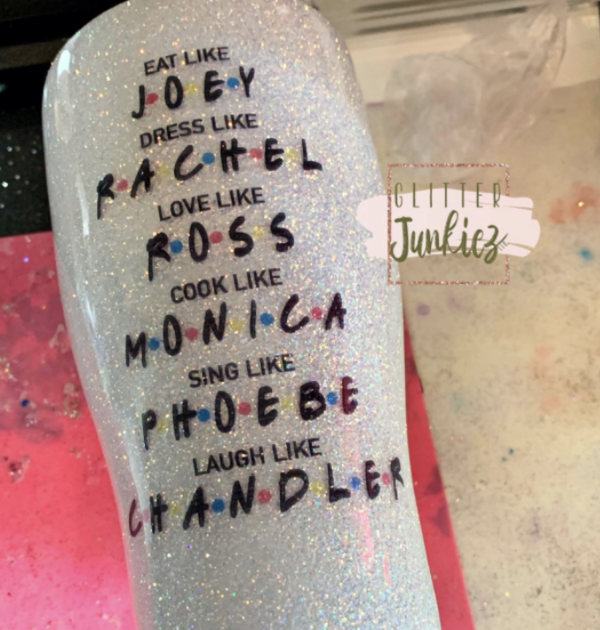
Mixing the two together may take a while. The length of time it takes will depend on the specific product, but you must always be careful to mix slowly or you will introduce air bubbles into the mixture. It can take several minutes of continuous mixing before the epoxy is ready to use. You will know that mixing is complete when the epoxy turns from cloudy and opaque to clear with no white streaks remaining.
Be careful to scrape the sides of the container while mixing. If any unmixed resin or hardener remains on the sides of the bucket, when you pour it out it will create uncured wet spots in the epoxy. When you pour the epoxy out, do not scrape the sides or bottom of the bucket to try and get all of the epoxy out. No matter how thoroughly you mixed, there will be small bits of unmixed epoxy there.
Be sure not to leave the bucket unattended. Epoxy is formed by a thermal reaction, and if it's left in the bucket too long it can generate enough heat to begin smoking, and can then very quickly cure inside the bucket.
Make sure that the surface you are applying epoxy to is sanded, clean, and dust free, and always wear gloves when working with epoxy. While it is safe and non-toxic, it is very sticky and it will be difficult to remove if it gets on your skin.
As long as you buy food grade epoxy and cure it properly, it will be safe to use on surfaces that will come into contact with your food. If you have never used epoxy before, these instructions may be overwhelming. It really isn't as difficult as it seems, but even experienced epoxy users can have problems with the cure occasionally. For that reason, if you've never worked with epoxy before, it may be a good idea to do a couple of test batches first. Pick up a two by four or some wood from a hardware store and coat it with epoxy to make sure you have the process figured out before you coat a whole counter top in it. Once you're sure that you can cure the epoxy properly, you're good to go.